RESEARCH · PUBLISHED STUDIES

How stuttering research has changed

From speech coordination to brain networks: the studies, the models and the questions that remain open.

Let me guide you through the studies

To understand stuttering, I would start with a simple question: how do thoughts, sounds, movements and sensations come together to form a sentence? Research has approached this question from different perspectives. Here I trace the published studies and models gathered in my PhD slides, explaining what they contribute and what they leave unresolved.

My voice guides you through the material; the ideas and findings belong to the authors named. A model proposes an explanation, an experiment tests a question, and a meta-analysis brings together findings from several studies. Keeping these distinctions clear helps us understand research without turning every new hypothesis into a certainty.

Sources: Smith, A., & Weber, C. (2017) · Chang, S.-E., & Guenther, F. H. (2020)

A first distinction: not all stuttering has the same history

When I discuss different forms, I look at onset and the person’s history. Developmental stuttering generally begins in childhood and is described as a neurodevelopmental condition: it emerges while the networks that support speech are maturing. Its course can change over time, resolving in some children and persisting in others.

Acquired neurogenic stuttering can occur after a neurological injury or disease. It does not necessarily affect only adults, nor does it always correspond to damage in a single brain region. The slides also refer to acquired forms described in the literature as psychogenic: distinguishing them from neurological forms requires a clinical assessment, not a label based solely on stress.

Repetitions, prolongations and blocks describe what we hear. On their own, they do not explain the origin of the difficulty. This distinction matters: most models in the timeline concern developmental stuttering and cannot automatically be applied to all acquired forms.

Sources: Smith, A., & Weber, C. (2016) · Junuzović-Žunić, L., Sinanović, O., & Majić, B. (2021) · Ward, D. (2010)

The numbers change with the question we ask

Incidence counts new cases arising over a period; prevalence indicates how many people have the condition at a given time. In the Australian cohort studied by Reilly and colleagues, which included 1,619 children, cumulative incidence by age four was 11.2%. This does not mean that 11.2% of adults stutter.

That is why I always read a percentage alongside the age, location and length of observation. Månsson’s study concerns Bornholm, Denmark; Reilly’s concerns Melbourne, Australia. Their estimates do not measure the Italian population and do not predict the course for an individual child.

Sources: Reilly, S., et al. (2013) · Månsson, H. (2000)

MILESTONES IN THE SLIDES

Thirteen milestones, from 1981 to 2025

This is not a race in which the latest model erases all those before it. Each milestone brings a different aspect into focus: coordination, planning, movement initiation, development, attention, emotions or prediction.

The figures retain the original text from the publications. The captions explain their meaning, and you can open them at full size.

1981

Theoretical framework

Gerald N. Zimmermann, Anne Smith and John M. Hanley

Coordination becomes the starting point

Zimmermann, Smith and Hanley propose a unified framework centred on the coordination of speech movements. The focus shifts from the individual sound to the stability of a system that must prepare and initiate very rapid movements.

It helps me understand fluency as a dynamic balance: physiological, psychological and environmental conditions can influence motor function. This contribution is a conceptual framework, not evidence that everyone has the same coordination difficulty.

Sources: Zimmermann, G. N., Smith, A., & Hanley, J. M. (1981)

1993

Cognitive hypothesis

Albert Postma and Herman Kolk

Checking a word before saying it

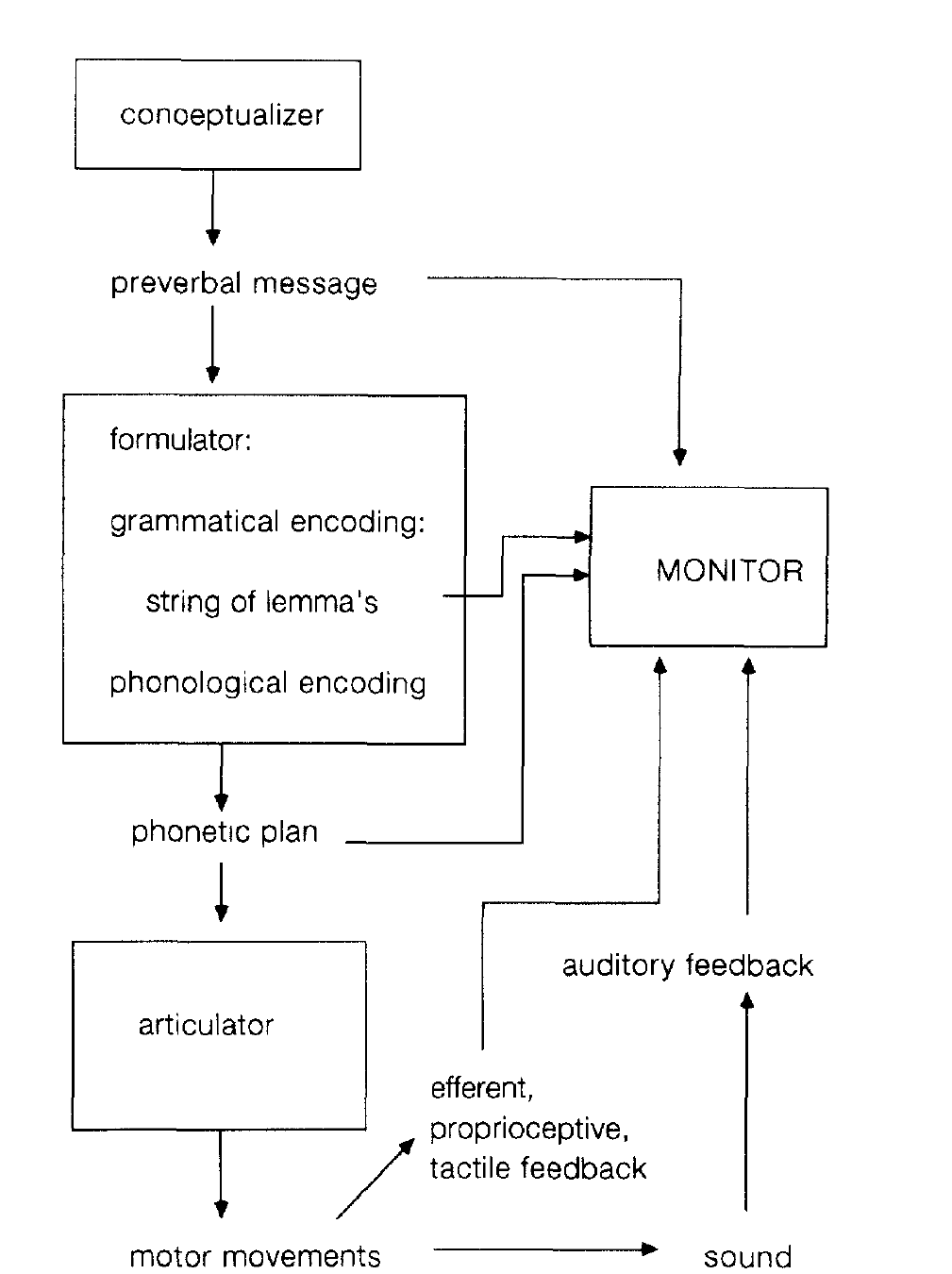
Albert Postma and Herman Kolk formulate the Covert Repair Hypothesis: before we speak, an internal system is proposed to check the sound plan and attempt to correct errors. According to the hypothesis, disfluencies would be the consequences of these hidden repairs.

I picture a sentence still being prepared, before it becomes speech: this is where the model looks for the interruption. It introduces monitoring as a research question, but does not allow us to claim that every block conceals a linguistic error that has actually been detected.

Sources: Postma, A., & Kolk, H. (1993)

Diagram showing conceptualisation, formulation, articulation and monitoring loops.
Speech monitoring diagram

The speech plan is constructed, checked and translated into movement. The diagram used in the slides on Postma and Kolk represents theoretical processes; the arrows are not brain measurements.

Enlarge the figure
2004

Review and neurobiological hypothesis

Per A. Alm

The right moment to initiate a syllable

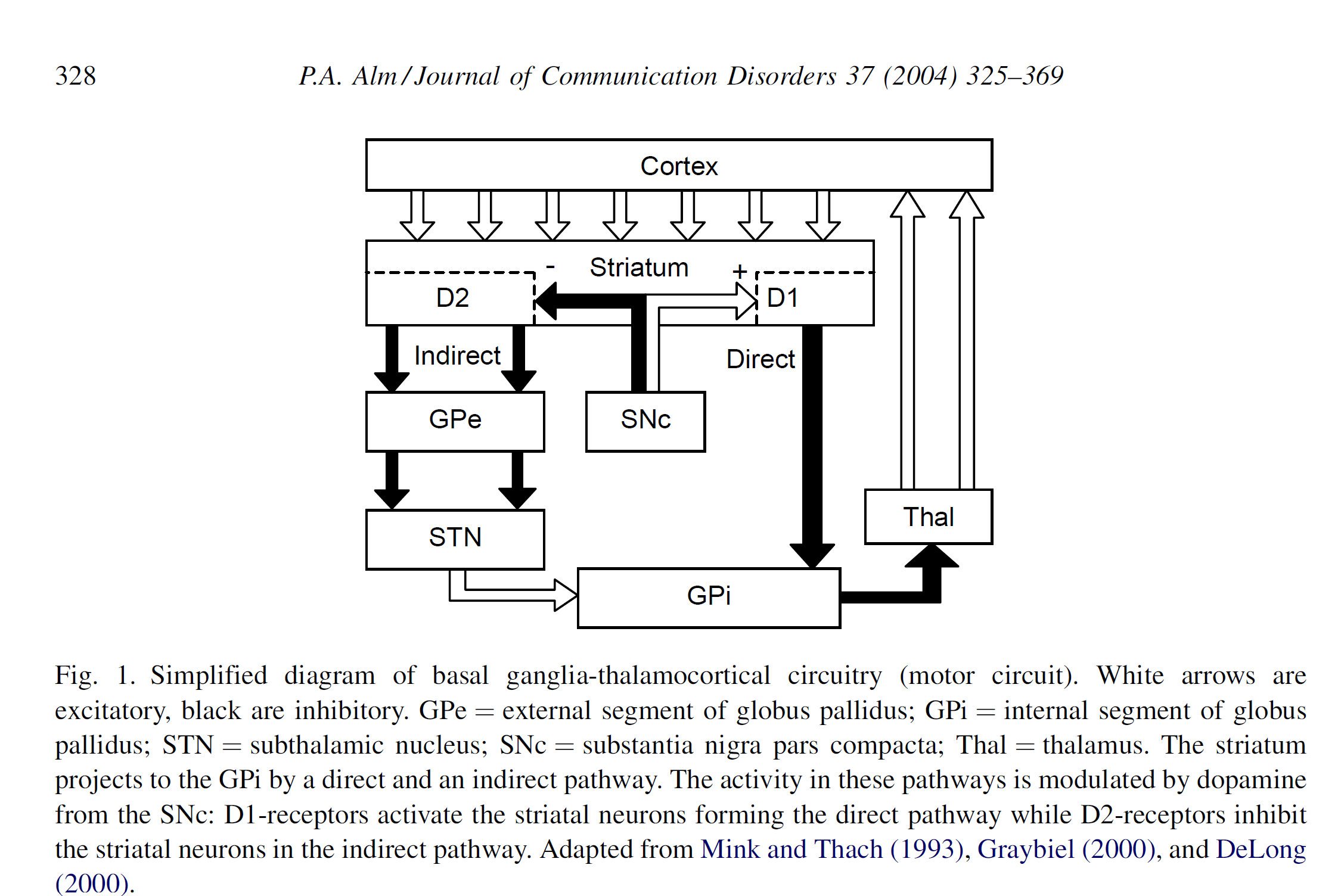
For Alm, the circuits linking the basal ganglia, thalamus and cortex deserve a central role. His review proposes a difficulty with the internal signals that help initiate speech sequences at the appropriate moment.

External rhythm, speaking in unison with others and singing become clues to explain. The aim is not to reduce everything to a muscle: the focus is on timing and coordination between circuits. This is an integrative interpretation of different lines of evidence, not proof of an identical alteration in everyone.

Sources: Alm, P. A. (2004)

Anatomical diagram of excitatory and inhibitory circuits between the cortex, basal ganglia and thalamus.
Basal ganglia circuits

Alm (2004), figure 1. The circuit links the cortex, basal ganglia and thalamus. It is a diagram of the connections discussed in the review, not a brain scan of a person who stutters.

Enlarge the figure
2012

Model and experimental study

Tedra A. Walden and colleagues

Language and emotions within a situation

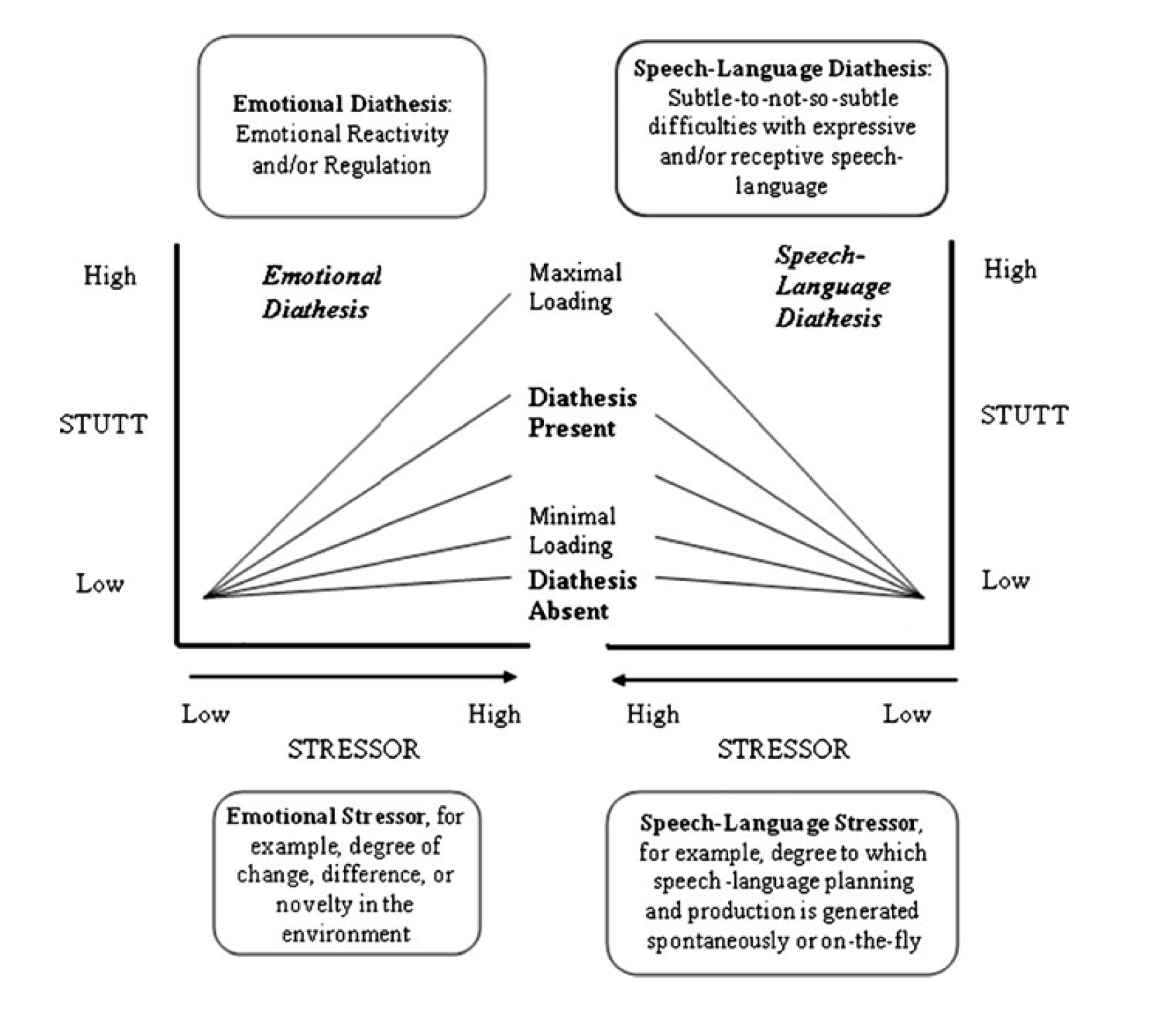
Walden and colleagues study how linguistic and emotional characteristics may interact with the demands of the context. In the Dual Diathesis–Stressor model, “diathesis” means a predisposition or vulnerability, not destiny.

The authors examine preschool children telling stories after conversations with different emotional content. For me, the useful insight is this: difficulty depends not only on the person or only on the environment, but on their interactions. No main effect of conversation type emerges: the interactions examined are what matter. The study does not demonstrate a cause based exclusively on anxiety, nor does it assign responsibility to parents.

Sources: Walden, T. A., et al. (2012)

Diagram of the Dual Diathesis–Stressor model for emotional and linguistic components.
Predispositions and contextual demands

Walden and colleagues (2012). The diagram places emotional and linguistic predispositions alongside the demands of the situation. The lines illustrate the model’s hypothesis; they are not diagnostic thresholds and do not indicate parental responsibility.

Enlarge the figure
2012

Three-factor theoretical model

Ann Packman

Why does the block happen at that particular moment?

Ann Packman distinguishes three factors in her model of an individual moment of stuttering: a difficulty in neural processing, features of speech that may trigger the episode, and factors that modulate its likelihood.

This perspective places variability at the centre: the same person may experience different difficulties in different sentences and situations. Distinguishing predisposition, triggers and modulation helps us avoid confusing what increases a difficulty with what gives rise to it. It remains a proposed causal model, not an experimental verification of each of its components.

Sources: Packman, A. (2012)

2013

Neurocomputational simulation

Oren Civier, Daniel Bullock, Ludo Max and Frank H. Guenther

A computer model attempts to initiate speech

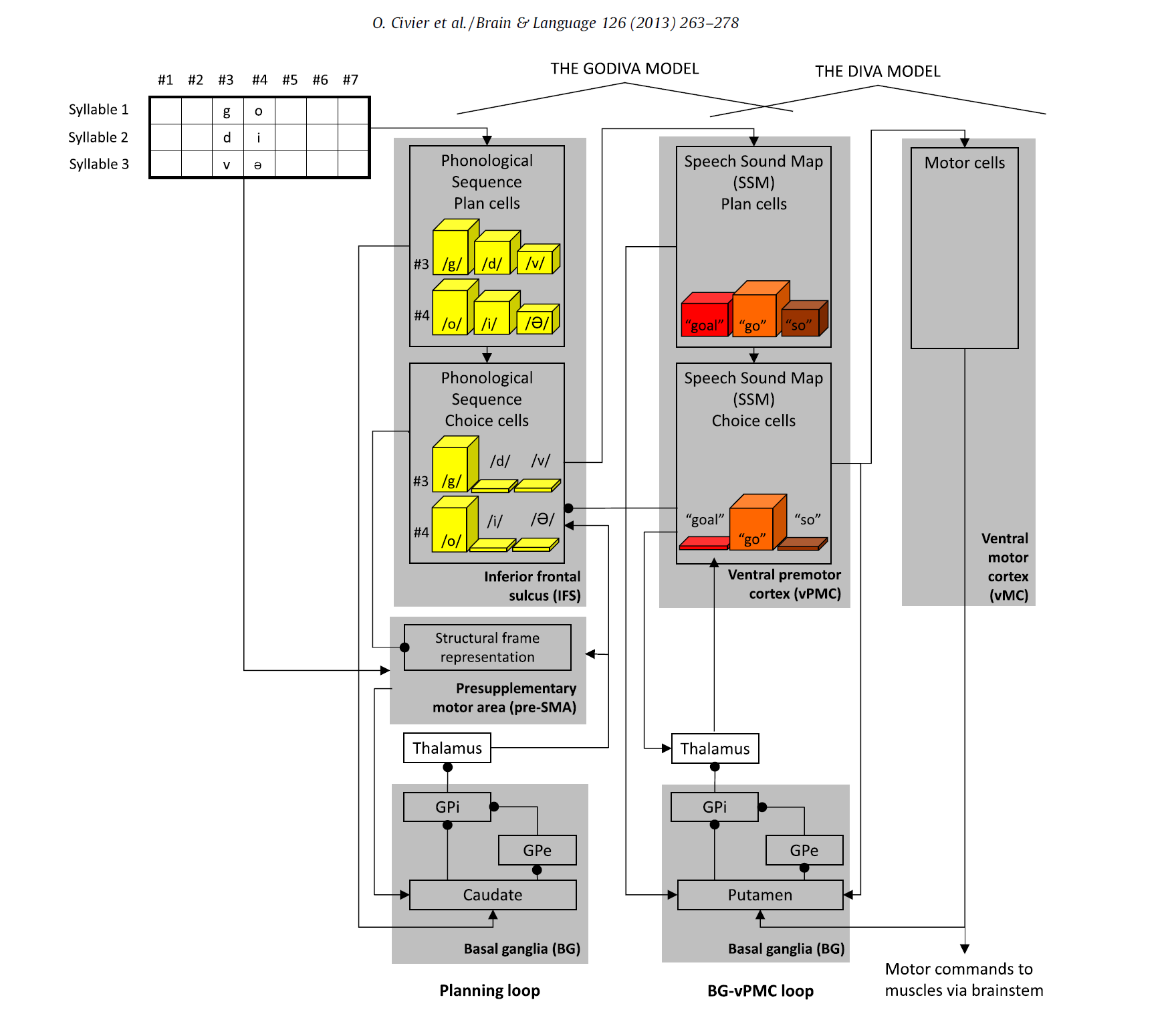
Oren Civier and colleagues use GODIVA, linked to the DIVA model, to simulate syllable selection and initiation. By altering certain properties of the basal ganglia circuit, the simulations produce difficulties in initiating sequences.

Here the explanation becomes precise enough to be implemented in a computational model. This goes beyond a verbal description: it allows us to observe what happens when a parameter changes. But a simulation consistent with stuttering does not demonstrate that this parameter is altered in the same way in every person’s brain.

Sources: Civier, O., Bullock, D., Max, L., & Guenther, F. H. (2013)

GODIVA/DIVA architecture with phonological planning, selection, basal ganglia and motor output.
Architecture of the GODIVA and DIVA models

Civier and colleagues (2013). The diagram links sequence planning, syllable selection and motor commands. It represents the simulation’s architecture: it shows how the model is organised, not an individual neuroimaging result.

Enlarge the figure
2015

Theoretical model of anticipation

Mauricio A. Garcia-Barrera and Jason H. Davidow

The feeling that a word will get stuck

Garcia-Barrera and Davidow address anticipation: how can someone sense an approaching moment of stuttering? Their model connects previous experiences and learned associations with speech monitoring.

This provides an important bridge between language processes and lived experience. Expecting a difficulty may have a history, linked to words, situations and consequences already experienced. The authors propose a theoretical explanation of this phenomenon; they do not argue that everyone anticipates every block or that anticipation is the sole origin of stuttering.

Sources: Garcia-Barrera, M. A., & Davidow, J. H. (2015)

2017

Integrative theory of development

Anne Smith and Christine Weber

Development can follow different pathways

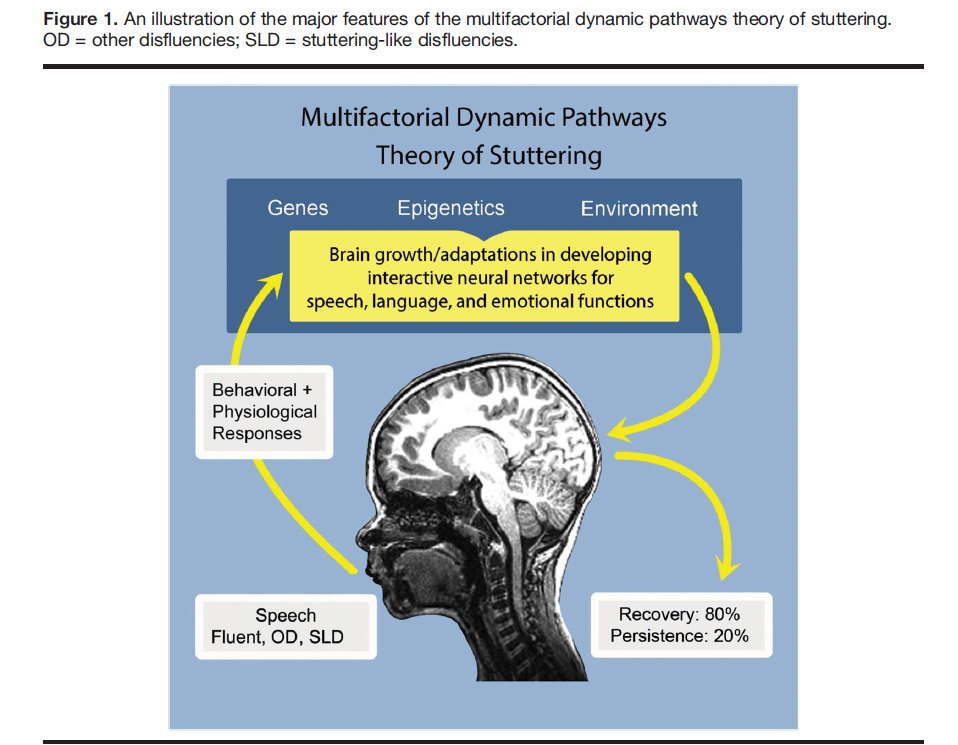
Anne Smith and Christine Weber present the Multifactorial Dynamic Pathways Theory. Stuttering emerges as motor, language and emotional networks develop and interact, under the influence of genetic and environmental factors.

The key word is “pathways”: there is no identical sequence for everyone. The systems involved, their relationships and the trajectory towards recovery or persistence vary. This perspective encourages me to look at development over time, avoiding interpreting a single performance as the definitive picture of a child.

Sources: Smith, A., & Weber, C. (2017)

Diagram of the Multifactorial Dynamic Pathways Theory showing motor, language and emotional networks.
Dynamic pathways in development

Smith and Weber (2017), figure 1. Genes, environment and network development interact over time. The percentages of 80% and 20% shown in the original diagram are the authors’ summary: they are neither an individual prognosis nor a treatment success rate.

Enlarge the figure
2019

Integrative review

Julie D. Anderson and Levi C. Ofoe

Executive functions coordinate demands

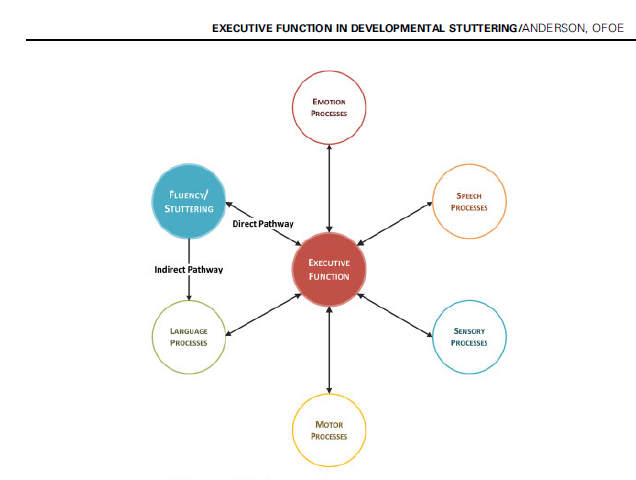
Julie Anderson and Levi Ofoe examine the roles of working memory, inhibition and attentional flexibility. These functions help us retain information, select responses and shift attention as demands change.

In their synthesis, executive functions interact with linguistic, motor, sensory and emotional processes. This idea helps explain why speaking while managing other demands may differ from speaking under simple conditions. The evidence, however, does not justify describing everyone who stutters as having a general executive function deficit.

Sources: Anderson, J. D., & Ofoe, L. C. (2019)

Executive functions at the centre of a diagram linked to five domains and fluency.
Executive functions and the other domains

Anderson and Ofoe (2019). The arrows connect executive functions to emotional, sensory, motor, linguistic and speech processes. The diagram represents theoretical relationships; it does not prove the presence of a deficit in each domain.

Enlarge the figure
2020

Neurobiological and computational review

Soo-Eun Chang and Frank H. Guenther

Connecting circuits, models and development

Soo-Eun Chang and Frank Guenther reinterpret behavioural and neurological data through the DIVA framework. They propose that a difficulty in the cortico–basal ganglia–thalamo–cortical circuit may interfere with the initiation of speech motor programmes.

The review connects hypotheses about movement with observations of the brain, also distinguishing what is observed in children from what may develop after years of stuttering. It is a mechanistic proposal: it seeks to explain how something happens. It is not a diagnostic test capable of automatically identifying the cause in an individual.

Sources: Chang, S.-E., & Guenther, F. H. (2020)

2022

Theoretical account of conflict and control

Evan R. Usler

When control and conflict become a research question

Evan Usler proposes a role for cognitive conflict: the system detects competition or difficulty and increases control. In his theoretical account, this response could contribute to interrupting the act of speaking.

I explain this as a question, not as criticism of people who monitor themselves: under what conditions do processes that usually help correct an action end up disrupting its continuity? It is an attempt to connect monitoring, control and development. It does not mean that simply stopping thinking about it would make someone fluent.

Sources: Usler, E. R. (2022)

2024

Integrative clinical model

Marie-Christine Franken and colleagues

A map that includes the impact on life

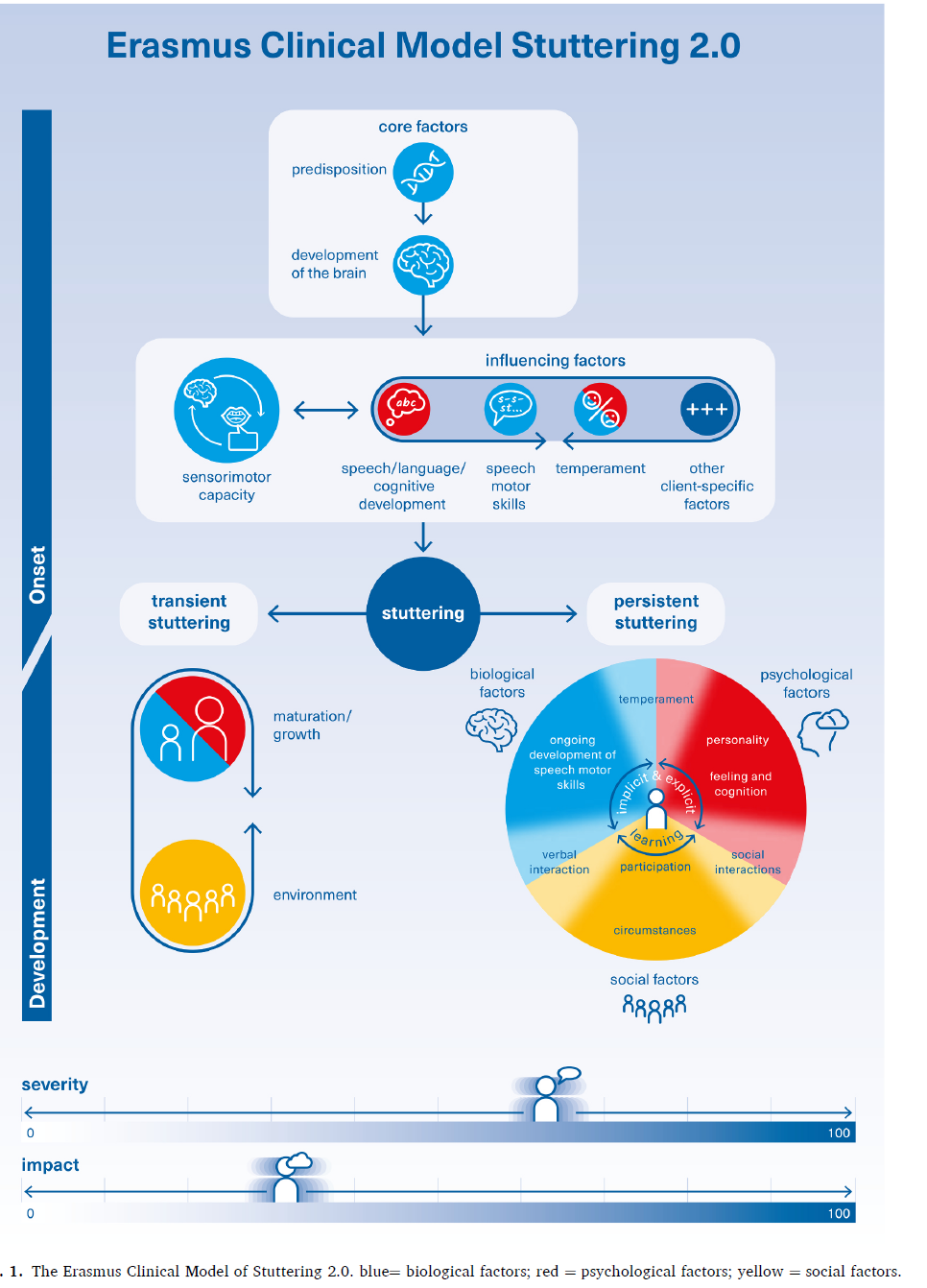
Franken and colleagues propose the Erasmus Clinical Model 2.0 to explain the onset and development of stuttering to individuals and families. The representation connects predisposition and brain development with biological, psychological and social factors.

I am interested in the visible distinction between speech severity and impact: the frequency of blocks and their burden on a person’s life are not the same measure. The model helps describe both dimensions. The life course illustrated in the article is a hypothetical case, not the result of an experimental follow-up.

Sources: Franken, M.-C., Oonk, L. C., Bast, B. J. E. G., Bouwen, J., & De Nil, L. (2024)

Erasmus Clinical Model 2.0, from predispositions to development and the dimensions of severity and impact.
Onset, development, severity and impact

Franken and colleagues (2024), figure 1. The Erasmus Clinical Model 2.0 includes biological, psychological and social components. The scales at the end distinguish speech severity from experienced impact: these are dimensions of the model, not a patient’s scores.

Enlarge the figure
2025

Theoretical account based on active inference

Evan R. Usler

Predicting, sensing and acting

In 2025, Usler uses active inference to interpret stuttering. The brain is described as a system that compares expectations with sensory signals and assigns them a weight. Here, “precision” refers to that weight or degree of confidence, not perfect pronunciation.

The author hypothesises that different timing of this regulation, or excessive attention to speech signals, may hinder syllable initiation. This is a recent theoretical proposal in the slides’ timeline. It connects perception and action, but does not yet provide a general demonstration or a validated clinical procedure.

Sources: Usler, E. R. (2025)

FINDINGS AND DIFFERENCES BETWEEN STUDIES

What measurements and comparisons across studies add

2007 · Keeping sounds in mind while we speak

Amit Bajaj reviews the possible involvement of working memory: the system that keeps information available while we use it. He focuses mainly on phonological memory and the central executive from Baddeley’s model.

Repeating invented words reduces the help provided by familiarity; speaking while performing a second task increases coordination demands. These paradigms allow different questions to be asked, but performance also involves perception, planning and articulation. The review does not present a new single cause of stuttering: it explores connections that require further testing.

Sources: Bajaj, A. (2007)

2008–2015 · Observing the brain during development

Studies by Chang and colleagues also turn the focus to children, to distinguish developmental characteristics from the possible consequences of many years of stuttering. In 2015, they examine white matter in 77 children aged three to ten: 37 who stutter and 40 controls.

The observed differences concern measurements of brain connections involved in sensory and motor integration. An MRI measure, however, is not a direct picture of the cause of a block. Group comparisons help formulate explanations; on their own, they do not constitute an individual diagnostic test.

Sources: Chang, S.-E., et al. (2008) · Chang, S.-E., Zhu, D. C., Choo, A. L., & Angstadt, M. (2015)

2011–2024 · Errors do not always produce the same response

Arnstein and colleagues find a larger ERN response in adults during a phonological rhyming task, even independently of actual errors. The ERN is an electrical component associated with action monitoring. The result informs hypotheses about speech control without proving universal causality.

Liu and colleagues, by contrast, study 24 children who stutter and 24 controls, aged three to nine. In the Go/No-Go task, they find no average group differences in either ERN or Pe. Different relationships emerge with age for ERN and with anxiety for Pe. I draw a specific caution from this: results in adults and children, obtained using different tasks, are not interchangeable.

Sources: Arnstein, D., Lakey, B., Compton, R. J., & Kleinow, J. (2011) · Liu, Y., et al. (2024; online 2023)

2018 · Memory, inhibition and attention in children

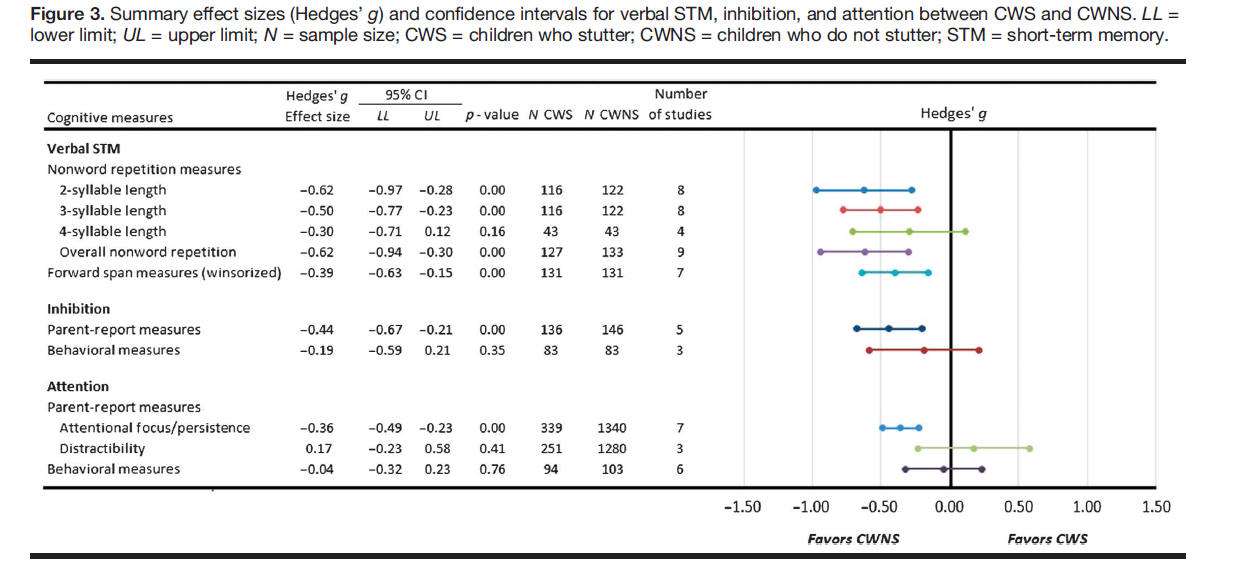
Ofoe, Anderson and Ntourou bring together 29 studies. The average difference in nonword repetition is g = −0.62: a statistical measure of the difference between groups, not a percentage of ability lost. Differences also emerge in other measures of verbal short-term memory.

The most useful detail is the distinction between assessment tools: parent questionnaires indicate differences in some aspects of inhibition and attention, while behavioural measures of these functions show no significant overall differences. The meta-analysis supports the importance of specific cognitive processes, not a global deficit in all children.

Sources: Ofoe, L. C., Anderson, J. D., & Ntourou, K. (2018)

Average effects and confidence intervals for verbal memory, inhibition and attention in children.
How findings differ across memory, inhibition and attention

Ofoe and colleagues (2018), figure 3. Points and intervals summarise differences between groups. The rows distinguish direct tasks from parent questionnaires. The chart does not imply that every child shows the reported average differences.

Enlarge the figure

2019–2020 · Attention in adults, study by study

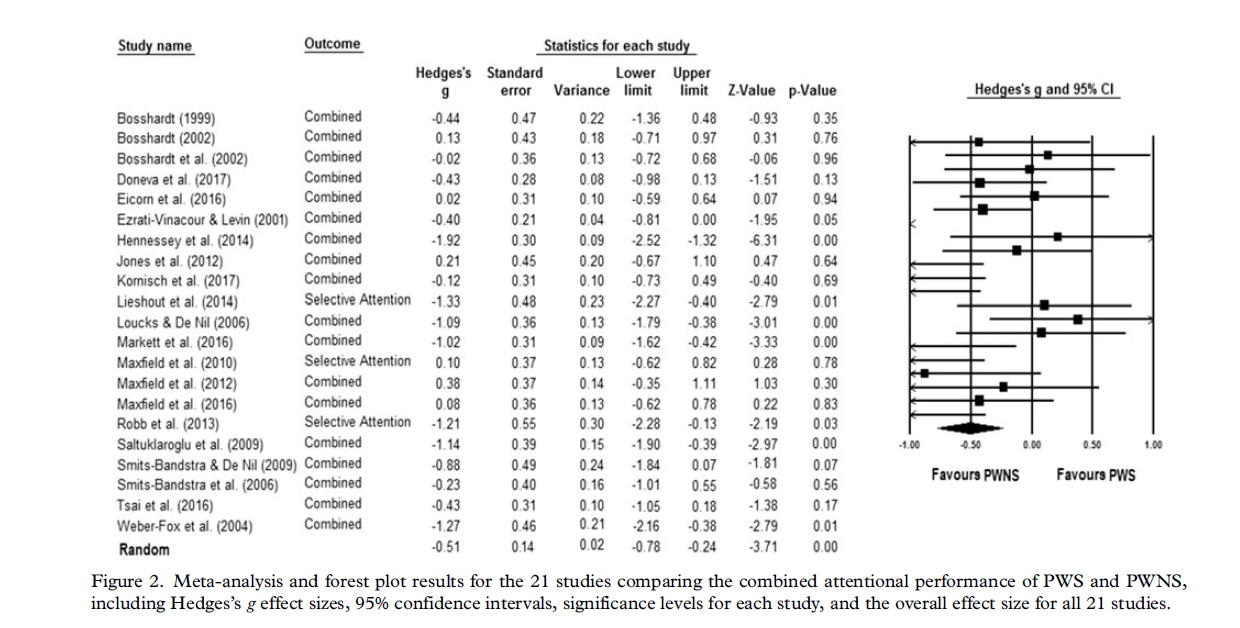
Silviya Doneva’s meta-analysis, published online in 2019 and in a journal volume in 2020, brings together 21 studies of attention in adults. Overall, performance is lower in the group who stutter; this pattern is confirmed in the analyses of selective attention and dual-task performance.

The effect does not appear in every study, however. In the chart, each row represents a comparison, and the horizontal line shows its uncertainty. The overall result describes an average: it does not justify saying that everyone who stutters has an attention problem, or that attention is the sole cause of stuttering.

Sources: Doneva, S. P. (2020; online 2019)

Forest plot of 21 studies on attentional performance in adults who stutter and controls.
Twenty-one comparisons of attention in adults

Doneva (online 2019; journal volume 2020), figure 2. Each row represents a study; the diamond summarises the overall effect. The position and width of the intervals show why an average result does not describe everyone in the same way.

Enlarge the figure

Today’s question is how the systems interact

This evolution shows why an explanation based solely on emotions is insufficient. Motor function, language, perception, attention and personal experience feature in different models, with different evidence and limitations. Research seeks to clarify how they influence one another over time.

The message I want to make accessible is this: understanding stuttering requires connecting speech with the person and their development, without reducing the person to a chart. The publications discussed here offer knowledge and questions; on their own, they are not evidence of the effectiveness of a specific programme.

Sources: Smith, A., & Weber, C. (2017) · Anderson, J. D., & Ofoe, L. C. (2019) · Franken, M.-C., Oonk, L. C., Bast, B. J. E. G., Bouwen, J., & De Nil, L. (2024)

PhD Researcher · Emanuele Giuseppe Adiletta

READ THE SOURCES

The publications

The references follow the studies discussed in the slides. Titles and author names retain their original bibliographic form.

  1. Zimmermann, G. N., Smith, A., & Hanley, J. M. (1981). Stuttering: In need of a unifying conceptual framework.

    Open the publicationDOI: 10.1044/jshr.2401.25
  2. Postma, A., & Kolk, H. (1993). The Covert Repair Hypothesis: Prearticulatory Repair Processes in Normal and Stuttered Disfluencies.

    Open the publicationDOI: 10.1044/jshr.3603.472
  3. Alm, P. A. (2004). Stuttering and the basal ganglia circuits: A critical review of possible relations.

    Open the publicationDOI: 10.1016/j.jcomdis.2004.03.001
  4. Walden, T. A., et al. (2012). Dual Diathesis–Stressor Model of Emotional and Linguistic Contributions to Developmental Stuttering.

    Open the publicationDOI: 10.1007/s10802-011-9581-8
  5. Packman, A. (2012). Theory and therapy in stuttering: A complex relationship.

    Open the publicationDOI: 10.1016/j.jfludis.2012.05.004
  6. Civier, O., Bullock, D., Max, L., & Guenther, F. H. (2013). Computational modeling of stuttering caused by impairments in a basal ganglia thalamo-cortical circuit involved in syllable selection and initiation.

    Open the publicationDOI: 10.1016/j.bandl.2013.05.016
  7. Garcia-Barrera, M. A., & Davidow, J. H. (2015). Anticipation in stuttering: A theoretical model of the nature of stutter prediction.

    Open the publicationDOI: 10.1016/j.jfludis.2015.03.002
  8. Smith, A., & Weber, C. (2017). How Stuttering Develops: The Multifactorial Dynamic Pathways Theory.

    Open the publicationDOI: 10.1044/2017_JSLHR-S-16-0343
  9. Anderson, J. D., & Ofoe, L. C. (2019). The Role of Executive Function in Developmental Stuttering.

    Open the publicationDOI: 10.1055/s-0039-1692965
  10. Chang, S.-E., & Guenther, F. H. (2020). Involvement of the Cortico-Basal Ganglia-Thalamocortical Loop in Developmental Stuttering.

    Open the publicationDOI: 10.3389/fpsyg.2019.03088
  11. Usler, E. R. (2022). Why Stuttering Occurs: The Role of Cognitive Conflict and Control.

    Open the publicationDOI: 10.1097/TLD.0000000000000275
  12. Franken, M.-C., Oonk, L. C., Bast, B. J. E. G., Bouwen, J., & De Nil, L. (2024). Erasmus clinical model of the onset and development of stuttering 2.0.

    Open the publicationDOI: 10.1016/j.jfludis.2024.106040
  13. Usler, E. R. (2025). An active inference account of stuttering behavior.

    Open the publicationDOI: 10.3389/fnhum.2025.1498423
  14. Bajaj, A. (2007). Working memory involvement in stuttering: Exploring the evidence and research implications.

    Open the publicationDOI: 10.1016/j.jfludis.2007.03.002
  15. Ofoe, L. C., Anderson, J. D., & Ntourou, K. (2018). Short-Term Memory, Inhibition, and Attention in Developmental Stuttering: A Meta-Analysis.

    Open the publicationDOI: 10.1044/2018_JSLHR-S-17-0372
  16. Doneva, S. P. (2020; online 2019). Adult stuttering and attentional ability: A meta-analytic review.

    Open the publicationDOI: 10.1080/17549507.2019.1665710
  17. Liu, Y., et al. (2024; online 2023). Brain response to errors in children who stutter.

    Open the publicationDOI: 10.1016/j.jfludis.2023.106035
  18. Arnstein, D., Lakey, B., Compton, R. J., & Kleinow, J. (2011). Preverbal error-monitoring in stutterers and fluent speakers.

    Open the publicationDOI: 10.1016/j.bandl.2010.12.005
  19. Chang, S.-E., et al. (2008). Brain anatomy differences in childhood stuttering.

    Open the publicationDOI: 10.1016/j.neuroimage.2007.09.067
  20. Chang, S.-E., Zhu, D. C., Choo, A. L., & Angstadt, M. (2015). White matter neuroanatomical differences in young children who stutter.

    Open the publicationDOI: 10.1093/brain/awu400
  21. Smith, A., & Weber, C. (2016). Childhood Stuttering: Where Are We and Where Are We Going?

    Open the publicationDOI: 10.1055/s-0036-1587703
  22. Junuzović-Žunić, L., Sinanović, O., & Majić, B. (2021). Neurogenic Stuttering: Etiology, Symptomatology, and Treatment.

    Open the publicationDOI: 10.5455/medarh.2021.75.456-461
  23. Ward, D. (2010). Sudden onset stuttering in an adult: Neurogenic and psychogenic perspectives.

    Open the publication
  24. Reilly, S., et al. (2013). Natural history of stuttering to 4 years of age: A prospective community-based study.

    Open the publicationDOI: 10.1542/peds.2012-3067
  25. Månsson, H. (2000). Childhood stuttering: Incidence and development.

    Open the publication

KEEP EXPLORING

From studies to questions.

My research journeyUnderstanding stuttering
FLUENTEMENTE PARLANDO · VIDEOS

Open on YouTube

Educational content: each programme requires an individual assessment.